
Chemistry
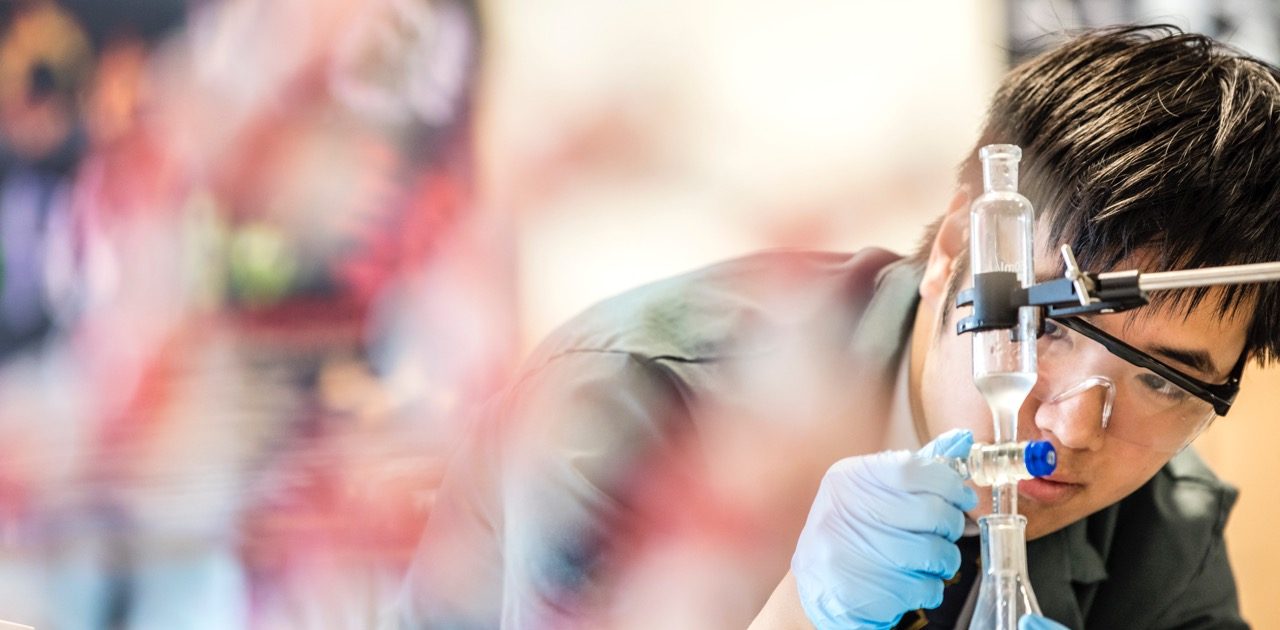
Chemistry at Caterham is fun!
We all do chemistry every day.
As soon as you wake up in the morning, you start doing chemistry. Chemistry explains why an egg changes when you fry it and why your non-stick pan is non-sticky, how soap and shampoo make you clean, why you feel tired before coffee and alert after it, and how the petrol in your car gets you to school or work.
In the First Year, pupils study chemistry as part of an integrated science course, learning basic experimental skills and generally becoming familiar with practical work and competent with the use of equipment.
By the Second Year, chemistry is taught as a separate subject by a specialist teacher. The pupils follow an in-house course that aims to maintain a practical emphasis whilst focusing on key areas of chemistry such as qualitative testing and acids.
In the Third Year, pupils begin to study for the Edexcel IGCSE Triple Science qualification. There is the option in the Fifth Year to take the Science Double Award, but the majority continue with the three separate sciences.
At A Level we follow the OCR A specification. There is a heavy emphasis upon practical work, and this serves as good preparation for the practical endorsement, the exam, and future scientific work at university and beyond.
All A level chemists are encouraged to participate in the various RSC promoted activities, culminating in many sitting the Olympiad and the C3L6. Pupils have won many Gold Awards in recent years. A team were also very successful at the Chemistry Race last year.
The vast majority of the A Level chemists go on to study chemistry-related degree courses at good universities, including Oxford and Cambridge.
BIOGRAPHIES
David Keyworth, MSc, Head of Chemistry
David is a graduate of the University of Salford with an MSc from the University of Wales. After a time in academic biochemical research into parasitology he went on to study for a PGCE. David has been Head of Chemistry since he joined Caterham in 2006. Amongst his interests are running, reading and rock climbing.
Mr Anil Nagar, BSc, ARCS, MRSC, 2 i/c Chemistry
After graduating from Imperial College, Anil joined the Teach First programme and has been teaching since 2004, arriving at Caterham in 2019. He has since joined the Go Karting club and has learnt he has no prospects as a racing driver. Outside of the lab he is a passionate cook and enjoys experimenting with different flavours. He also enjoys rock climbing, cycling and wine tasting.
Mr Richard Evans, MChem, Teacher of Chemistry, Head of Ridgefield
Richard is a graduate of the University of Southampton’s School of Chemistry. In 2013, he represented his alma mater in BBC Two’s University Challenge, winning one of his matches with the twelfth-highest margin of victory since the series began on the BBC in 1994. After working as a research intern in the UK and as a summer camp lifeguard in Ohio, USA, he completed a PGCE, and took up his post at Caterham School in 2017. He is steadfast in his belief that anyone who masters just a few key chemical principles is on course to become an excellent chemist. He is also the Head of Ridgefield House. He enjoys swimming, quizzing, theatre, and watching triathlons, and you can always find him at meetings of the Moncrieff-Jones Science Society and at the annual Charity Talent Show.
Dr Robert Soltysiak, MChem PhD, Teacher of Chemistry, Junior Science coordinator, Head of Harestone
Rob joined Caterham in 2016 after finishing a PhD in Synthetic Chemistry at the University of Manchester, working on potential new cancer treatments. Having taught in the undergraduate laboratories while completing his research, he decided to start teaching younger students and pushing them to think critically about the world around them. He runs the Junior Science curriculum and believes that our youngest students in the senior school should be able to link key concepts of the three main sciences and see the relevance to everyday life. Outside of the classroom Rob spends time coaching rugby, running mountain biking and looking after the school bees, as well as leading Harestone House to victory. When not at school he can be found hiking, biking and generally enjoying mountains and forests, or cooking.
Dr Iona Ross, MChem, Teacher of Chemistry
Iona started her teaching career in 2017, after completing her PhD on cathode materials for solid oxide fuel cells based at the University of St. Andrews. She discovered her passion for teaching while working with local schools during her studies. Iona arrived at Caterham in 2023. Beyond the classroom, Iona takes delight in pursuits such as singing, dancing (Scottish country and ballroom), and travelling to discover new tastes and experiences.
Miss Katie Essex BSc, Teacher of Chemistry
Katie is a graduate of the University of Warwick. Whilst studying there she volunteered at several schools and found a real passion for sharing her love of Chemistry with young minds. She completed her PGCE in 2014 straight after her bachelor’s and has enjoyed being in the classroom ever since. She also enjoys taking part in extracurricular activities which have ranged from Duke of Edinburgh to singing in the chamber choir. Katie joined Caterham in September 2023 from a smaller independent school and is really looking forward to getting stuck in.